Chad Navidson
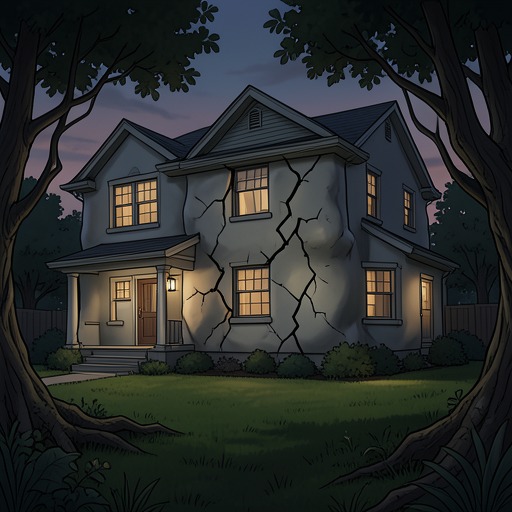
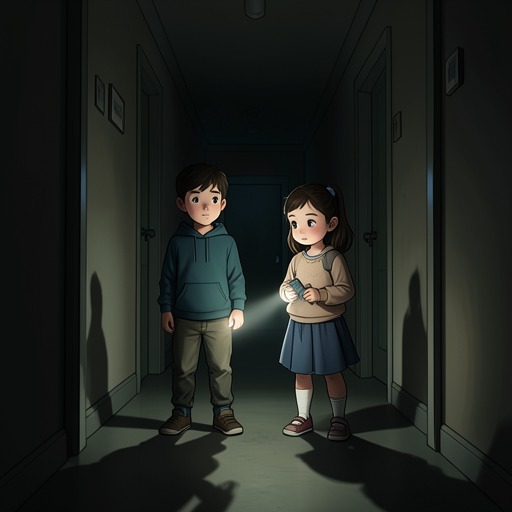
House of LeavesChad Navidson is Will Navidson and Karen Green’s son and Daisy Navidson’s older brother. Introduced during the family’s move from the city to Virginia, he is more self-conscious and serious than his younger sister, and his responses register the strain of being uprooted before he possesses any knowledge of the future. His importance lies less in conventional action than in the precision with which his habits and images disclose the psychological cost of the house.
Identity and Introduction
Chad is three years older than Daisy, who is five when the children are interviewed about their new home. While Daisy readily approves of the house, Chad misses the sounds of city traffic. Trucks and taxicabs had served as a kind of evening lullaby, and the rural quiet makes it difficult for him to sleep. When Will Navidson asks whether crickets might provide a substitute, Chad says that their sound is like something waiting. He then retreats into the safer, more familiar explanation that he simply likes traffic.
The distinction matters because Chad’s unease is initially easy to misread. The narrative explicitly cautions against treating his seriousness as premature knowledge of the film’s ending. At that stage, he is responding to a child’s ordinary dislocation: a move away from the city, a new environment, and the loss of familiar sounds. Yet the ordinary explanation does not cancel the foreboding. His language gives the pastoral setting an unseen presence, turning silence from a neutral absence into an active condition.
Family Context and Growing Isolation
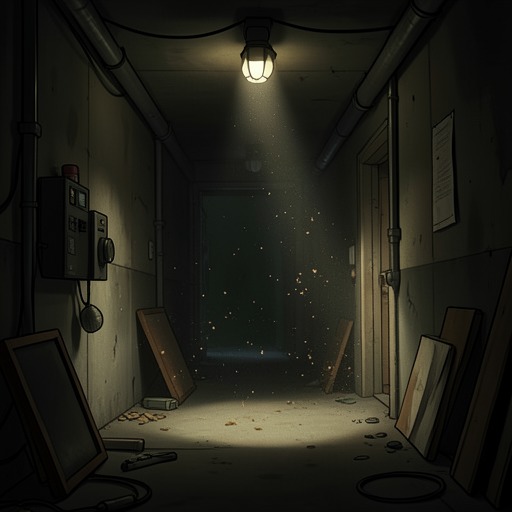
Chad’s unease develops within a family already destabilized by adult conflict. Will’s project is presented as an attempt to document reconciliation with Karen after nearly eleven years of professional departures and brief returns. The couple’s physical and emotional distance, Karen’s fear of the interior space, and Will’s fixation on entering it create a domestic crisis that the children cannot control but must inhabit.
Karen understands that the children are in trouble and tells them that, once their father returns, she will take them to their grandmother’s house. Her protective intention is undermined when Will, Tom Navidson, and Billy Reston descend into the hallway. Karen is torn between monitoring the radios and caring for Chad and Daisy, and she ultimately remains at the radios because separation from Will is more painful. Chad and Daisy try to draw her away from her post, but her inability to concentrate on them drives them off. The children therefore experience the house not only as a threatening environment but also as a place where parental attention is repeatedly redirected toward danger.
Chad’s position is further complicated by the history between Will and Tom. Tom is Will’s fraternal twin, and the brothers had barely spoken for more than eight years. Accounts of their estrangement suggest that Tom felt abandoned when Will’s attention shifted toward raising a family after Chad’s birth; he sometimes described himself as orphaned at forty, the age when Chad was born. Chad thus occupies an emotionally charged place in the family system: his arrival is associated with the reorganization of the brothers’ bond, even though he is not responsible for it and cannot understand its history.
Drawings and the House’s Threat
The clearest transformation in Chad’s characterization appears in his drawings. A week before Will’s rescue attempt, his third-grade teacher, Teppet C. Brookes, asks the class to draw a picture of a house. Chad submits an image with no chimney, windows, or door. Nearly ninety percent of the page is filled by a black square, built up through several layers of crayon and pencil until no paper shows through. In the narrow margins he places marauding creatures.
The image is more severe than the violent wolves, tigers, and dragon that appear elsewhere in the children’s drawings. Brookes interprets it as an expression of stress caused by the move to Virginia and notes that Chad has already been involved in playground scuffles. That explanation remains plausible, but the drawing also translates the house into an almost totalized darkness: a structure without openings, thresholds, or visible means of escape. The creatures occupy only the margins, while the black square consumes the page.
The image recurs and intensifies. Chad and Daisy’s room contains numerous drawings in which the monstrous square becomes progressively larger and darker; in Chad’s case, eventually even the barest margin disappears. The repeated expansion gives visual form to a pressure that cannot be contained by the page. Crayon, colour, and imperfect child-made shapes communicate the house’s horror differently from the documentary footage, suggesting that the children’s pictures capture the loss of light in their lives more directly than the cameras do.
Behavior During the Crisis
As the adults enter the house’s dangerous passage, Chad and Daisy react differently. Daisy retreats to her room, where she plays with her prized Spanish doll and the dollhouse Tom has finally completed for her. Chad instead prefers to go outside, disappearing into the woods that seem to summon him. He sometimes goes with Hillary, but increasingly he goes alone, beyond the range of every camera. His adventures and anger therefore pass unobserved, precisely when the family’s attention is fixed on the radios and on Will’s survival.
This withdrawal is not presented as a single dramatic rebellion. It is a gradual movement away from the family’s visible spaces and recording systems. The child who once described traffic as comforting now seeks distance from the house and from the adults whose divided loyalties leave him unattended. His behavior makes the family’s crisis cumulative: danger does not need to seize him directly to alter his world. Waiting, silence, drawings, missed sleep, and unmonitored excursions form a slow accumulation of fear.
Narrative Significance
Chad functions as an early-warning figure whose perceptions remain grounded in childhood rather than expert interpretation. He does not explain the house, lead an exploration, or resolve the adults’ conflict. Instead, his remarks and drawings expose what the adults’ documentary apparatus cannot fully contain. The cameras record rooms and expeditions; Chad’s black square records the domestic meaning of those events.
His story also clarifies the cost of Will and Karen’s attempted reconciliation. Will gives up assignments abroad, while Karen promises to concentrate on raising the family, but Will quickly takes refuge in the documentary, bringing the work and its authority into the home. Karen is unable to define a space of her own and needs help, while the children receive an increasingly fractured form of care. Chad’s fear is therefore both personal and systemic: it belongs to a boy coping with relocation, but it is intensified by a household in which love, danger, professional obsession, and parental absence have become inseparable.